Garage door opener repair in Lockeford, CA, about 8 miles from Lodi. Chain-drive openers on 1970s-built doors fail differently than newer belt-drive units nearby.
Most houses in Lockeford went up around 1979, a few years newer than the mix Lodi Garage Door Pros sees across the rest of the service area, where the median build year sits closer to 1974. That gap matters more than it sounds. A late-70s garage door out here is more likely to have shipped with a single steel panel and a chain-drive opener bolted straight to the header, not the quieter belt-drive units that started showing up in later remodels. The chain-drive units are simple machines, which is good news for a homeowner willing to get on a ladder.
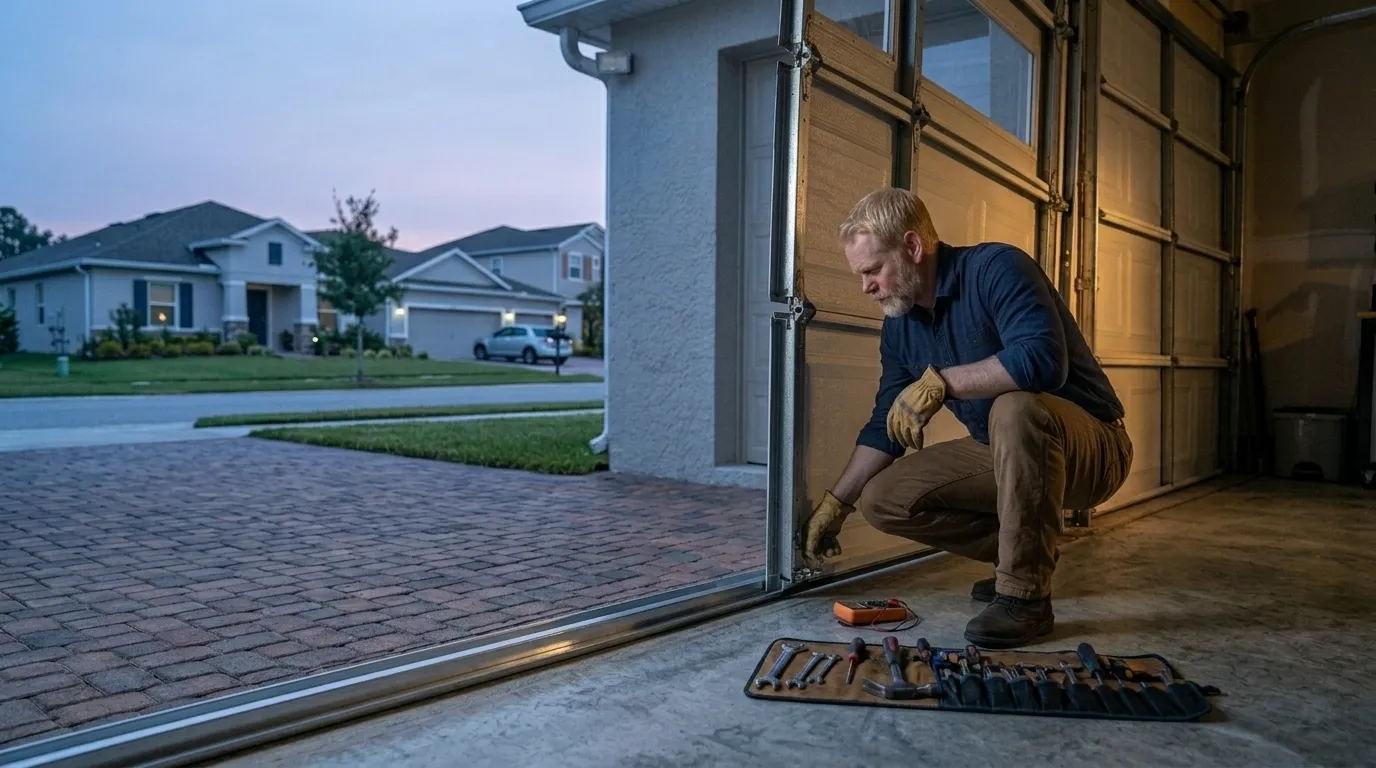
Swapping remote batteries, cleaning the photo-eye lenses, and snugging a loose header bracket are all fair game with a stepladder and a screwdriver. What isn't: opening the opener housing to get at the gear set, or trying to re-time a limit switch on a unit that's been running since Carter was in office. Those jobs need the cover off, the motor unplugged, and some sense of what a stripped nylon gear looks like versus a worn drive sprocket. Guess wrong and you can bend the rail or drop a door on a foot.
If the opener is original to the house, we'd rather look at it before you start pulling covers off.
How It Shows Up
The most common call from this side of the service area is a motor that hums but the door doesn't move, or moves an inch and stops. On the older chain-drive units, that's almost always the drive gear inside the housing, a nylon part that was never built to outlast the steel it's bolted to. You'll also hear it before you see it: a grinding or rattling noise as the chain drags without turning the sprocket properly.
Second most common: a remote that works standing at the door but not from the driveway or the truck. On units this age, that's usually a worn circuit board or a antenna wire that's come loose inside the housing, not a dead remote battery, though it's worth ruling that out first since it's free to check.
Less common but not rare: the door reverses immediately after closing, which on a chain-drive setup from this era is often a down-limit switch that's drifted out of adjustment rather than anything wrong with the safety sensors themselves. Each of these has a different fix, and none of them is solved by replacing the remote.
Why This Fails Locally
The heat band this area sits in is moderate, not extreme, but it's enough to matter for a garage that was built without much insulation, which describes a lot of the 1979-era stock here. A detached garage or an attached one with a single layer of drywall runs hot enough in summer that the nylon gear inside an opener housing goes through more expansion and contraction cycles than the same part would in a climate-controlled space. That's what strips the gear, not one bad day but years of it.
Ownership patterns play into this too. Across the wider service area, roughly 17,555 of 26,985 households are owner-occupied, and Lockeford's own household count sits around 1,491 with a median income near $93,438, a touch above the $91,429 figure for the broader area. People who've owned a house for decades tend to keep the original opener running as long as it runs, which means by the time it fails, the parts inside are as old as the door itself.
The honest limitation here: once a chain-drive gear kit for a unit this old is discontinued, and some are, repair stops being the cheaper option. We'll tell you straight when that's the case instead of hunting for a part that isn't coming.
What Can Go Wrong
Beyond the stripped gear kit, the parts most likely to fail on an opener this age are the capacitor that gives the motor its starting torque, the logic board if the unit ever got a lightning surge, and the down-limit switch that's been adjusted by hand one too many times. Any of these can look like the same symptom from the driveway, which is why a call that starts as "opener's dead" sometimes ends up being a five-minute limit adjustment and sometimes ends up being a new unit.
Safety-eye misalignment is worth a specific mention. On garages from this era that have settled slightly over 40-plus years, the two sensor brackets can drift out of true alignment by a fraction of an inch, enough that the door won't close at all, or closes and immediately reverses. It reads like a broken opener. It's usually a bent bracket.
What we won't do is sell a full opener replacement on a unit that just needs a gear kit and an adjustment. If the motor and board are sound, a repair on a chain-drive opener this age is usually the cheaper path, and we'll say so even when a new install would pay better.
How it works
From “it’s stuck” to “it’s fixed”
1
Tell us what’s wrong
Describe the symptom - won’t open, loud bang, opener runs but the door won’t move.
2
On-site diagnosis
A technician tests the door under power and by hand and finds what actually failed.
3
Clear, up-front plan
You get the fix that’s needed and what drives the cost - before any work starts.
4
Repaired & tested
The repair is done, the door is set true and tested, and the work area left clean.
Next step
Serving Lodi, CA - tell us what your door’s doing and we’ll take it from there.
Is it worth repairing an opener this old, or should I just replace it?
Depends what's actually broken. If it's the gear kit, capacitor, or a limit switch, repair is usually cheaper and the motor itself often has years left in it. If the logic board is fried or the gear kit for that model is discontinued, replacement makes more sense. We'll tell you which one you're looking at before we start any work.
Why does my opener work fine some days and grind on others?
Intermittent grinding on an older chain-drive unit is usually a gear that's partially stripped, catching cleanly some cycles and slipping others. Heat makes it worse since the nylon expands. It will keep getting more frequent, not less, so it's worth having looked at before it stops moving the door altogether.
Do you carry parts for openers this age on the truck?
We don't stock every gear kit or board for every model out there, especially on units from the late 1970s that have been discontinued by the manufacturer. We'll identify the model on the visit and let you know straight away whether the part is something we can get or something that's no longer made.
Ready to get your garage door sorted?
Tell us what it’s doing and where you are in Lodi - we’ll take it from there.